Shopify - Social Commerce Implementation
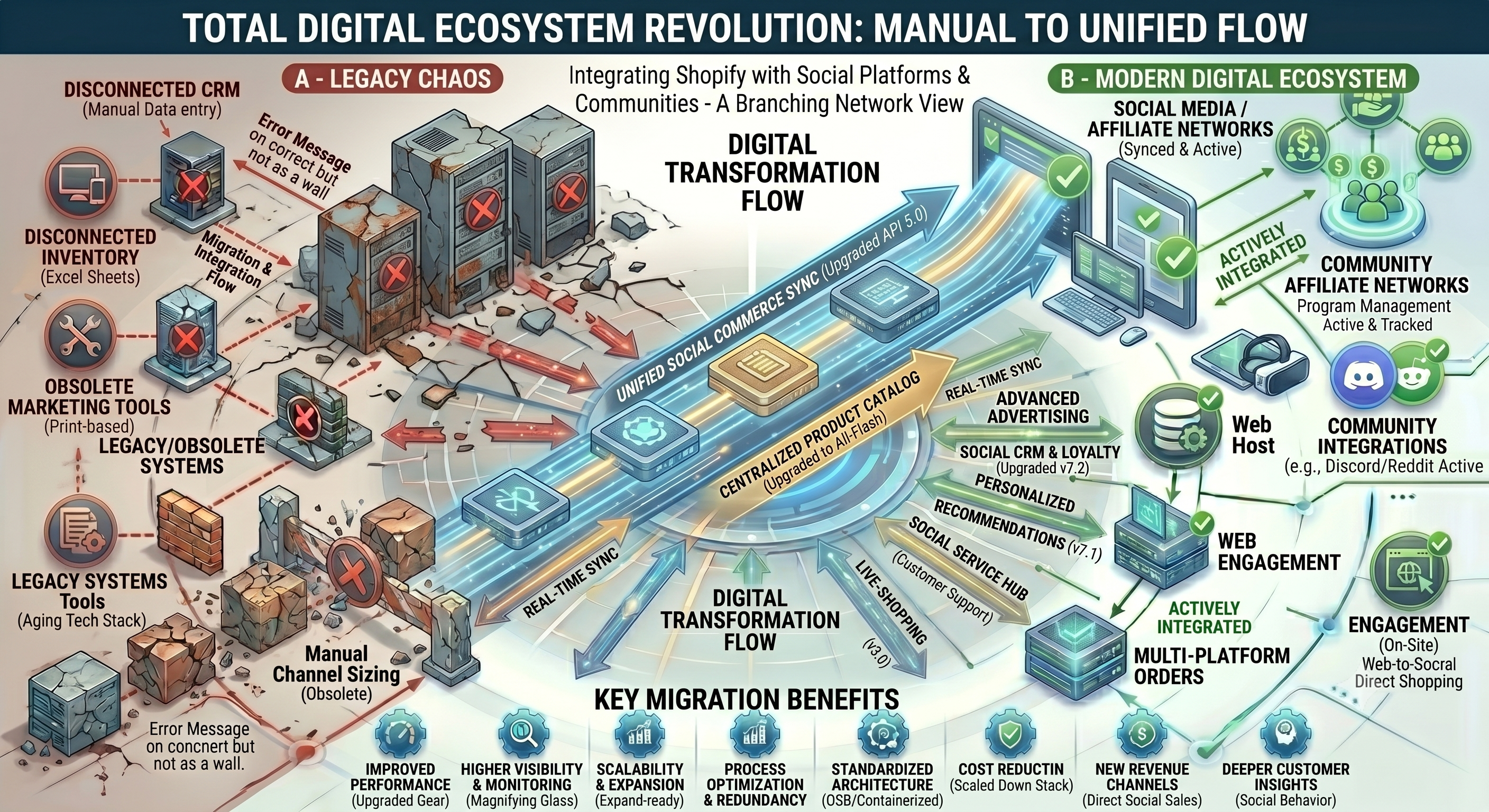
Shopify Social Commerce Pilot Project for Tupperware Asia Pacific. Introducing a new digital sales model that enabled Business-to-Consumer (B2C) selling through referral-based social commerce. The initiative empowered the sales force to share personalized Shopify referral links with end customers, allowing customers to purchase directly while ensuring sales attribution remained linked to the respective sales representative for commission and bonus calculations. In addition to technical delivery, I was responsible for end-to-end project leadership, including business case development, planning, cross-system integration, execution, and stakeholder reporting. The solution integrated Shopify with the existing front-end systems, JD Edwards (ERP), and DHL Warehouse Management System (WMS), establishing a scalable foundation for social commerce expansion across the Asia Pacific region.
Role / Contribution
Project Manager
Technology Stack
Compliances & Standards
PMP/ACP
IT Audit Compliance(SOX)
SDLC
The Challenge
The pilot project introduced a new commercial model that required alignment across business, technology, and logistics ecosystems.
Key challenges included:
- Implementing a social commerce model using Shopify referral links while ensuring accurate sales attribution to individual sales force members.
- Integrating Shopify with JD Edwards ERP and DHL WMS for order processing, inventory management, and fulfillment.
- Designing a system where sales data from end customers could be correctly mapped back to sales representatives for commission and bonus calculations.
- Establishing separation between sales force inventory and direct-to-consumer inventory, requiring logical warehouse and sales type configuration in JD Edwards.
- Managing fulfillment complexity with DHL, ensuring last-mile delivery directly to end customers rather than distributor-based shipping.
- Overcoming Shopify limitations in 2021, particularly the lack of multi-warehouse capability, which constrained fulfillment operations to a single warehouse (Jakarta).
- Coordinating multiple stakeholders across business, IT, logistics, and regional Asia Pacific teams.
- Ensuring scalability for future rollout across all Asia Pacific business units.
Strategic Solution
A structured pilot-to-scale strategy was implemented, combining business process design, system integration, and phased capability enhancement.
Key initiatives included:
- Led the full project lifecycle including business case development, planning, system design, execution, and reporting as Project Manager.
- Implemented Shopify-based social commerce with referral link tracking to enable direct sales attribution to sales force members.
- Integrated Shopify with Distributor Management System, JD Edwards ERP and DHL WMS to enable end-to-end order flow from customer purchase to fulfillment and delivery.
- Designed and implemented a logical warehouse structure in JD Edwards, separating:
- Sales force fulfillment inventory
- Direct-to-consumer (Shopify) inventory
- Defined distinct sales types in ERP to ensure accurate financial reporting and commission calculation for social commerce transactions.
- Coordinated with DHL to establish last-mile delivery workflows, ensuring shipments were delivered directly to end customers instead of distributor channels.
- Managed system constraints during early implementation (2021) when Shopify did not support multi-warehouse functionality, centralizing fulfillment in Jakarta as an interim solution.
- Led transition planning for the 2024 enhancement phase, enabling multi-warehouse operations and distributed fulfillment across multiple locations.
Impact & Results
The Shopify Social Commerce initiative successfully established a scalable foundation for direct-to-consumer digital commerce across Asia Pacific.
Key outcomes included:
- Successfully launched a pilot social commerce platform using Shopify for Tupperware Asia Pacific.
- Enabled sales force members to generate revenue through referral-based direct-to-consumer sales, expanding commercial reach beyond traditional distributor channels.
- Established accurate sales attribution mechanisms ensuring proper commission and bonus calculation for sales force-driven online transactions.
- Integrated Shopify seamlessly with Distributor Management Sytem, JD Edwards ERP and DHL WMS, enabling end-to-end order processing and fulfillment.
- Created a structured inventory and sales segmentation model through logical warehouses and sales types in ERP.
- Enabled last-mile delivery capability, improving customer experience through direct-to-consumer fulfillment.
- Overcame initial Shopify system limitations by successfully implementing centralized fulfillment and later transitioning to multi-warehouse operations in 2024.
- Expanded sales coverage from distributor-only channels to a direct consumer market model, significantly increasing market reach.
- Established a scalable blueprint for Asia Pacific-wide rollout, positioning Shopify as a strategic social commerce platform for the region.
- Delivered a measurable expansion in business reach, enabling a shift from traditional sales distribution to a modern digital commerce ecosystem.